

Put Down What You Pick Up
And, the art of practicing Awareness, Intention, & Action.


Maya and I were on the phone yesterday (one of our, typically, 5-7 phone conversations a day) when she started telling me about a woman she works with who had been making these subtle, sideways comments. Nothing dramatic. Nothing that would make a scene. Just enough tone. Just enough edge. Just enough “hmm” behind the words to make it land.
The kind of passive-aggressive that makes you question yourself for a second. Like, did I imagine that? Was that about me? Am I being too sensitive?
Maya knew it wasn’t about her. She said that almost immediately. “I know this is about her, not me,” she told me. “I can see it. I can tell it’s insecurity.” And she’s right. She’s perceptive. She understands people. She has enough awareness to separate herself from someone else’s projection.


And yet.
She couldn’t shake it.
It lingered. It replayed. It followed her into the next day and the next interaction. She found herself thinking about it longer than she wanted to. Longer than it deserved.
She knew she should be able to let it go. But knowing that and actually doing it? Two very different things.
Earlier this week, we were in a separate text conversation with one of her friends. Different situation, same theme. This one wasn’t about someone else’s tone or insecurity. It was about her own voice inside her head. The running commentary. The quiet self-criticism. The habit of replaying mistakes and magnifying them. She was frustrated with herself for not being able to drop it. For letting one small thing color an entire day.
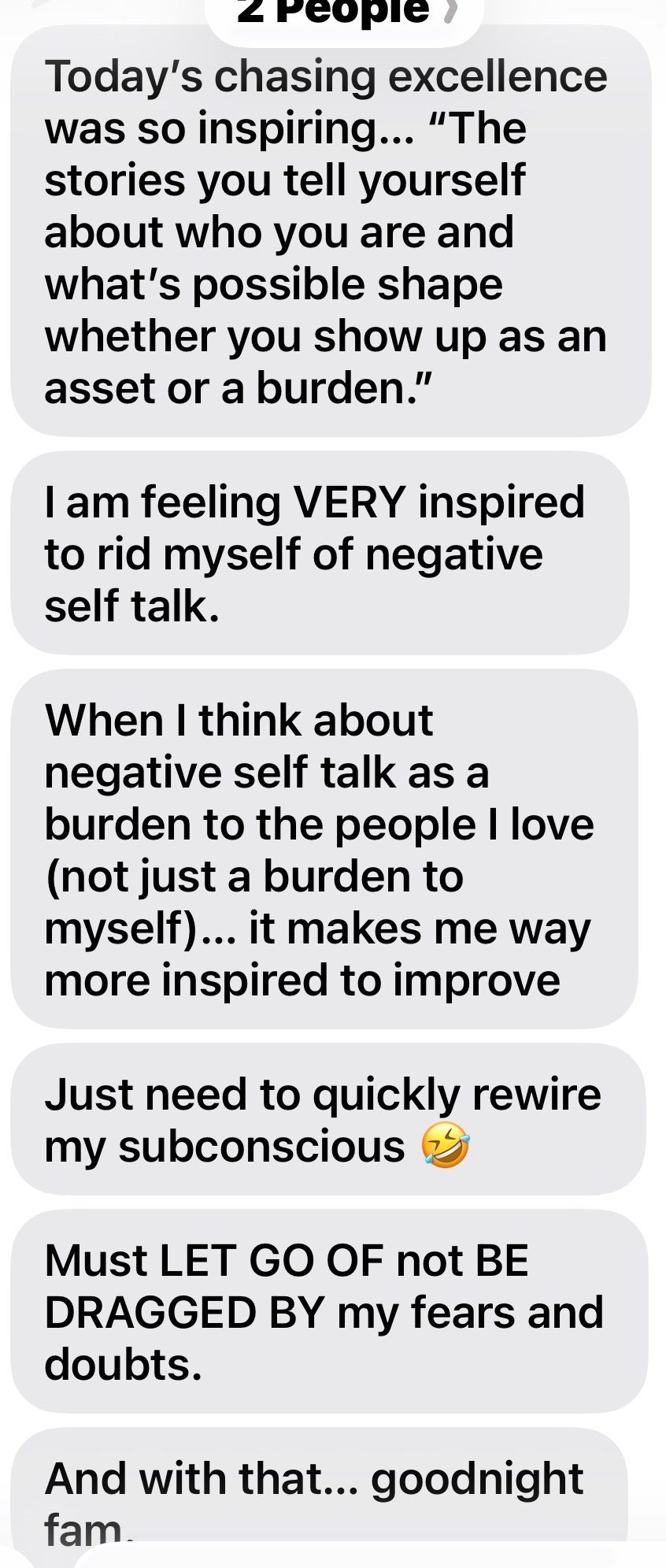
And what struck me in both conversations was this: they both wanted to let go. They both knew, logically, that what they were holding onto didn’t belong to them. And still, they held it.
It’s so easy to tell someone, “Just ignore it.” Or, “Don’t let it bother you.” Or my personal favorite, “Why do you care what they think?” As if detachment is a switch you flip. As if awareness automatically equals freedom.
But that’s not how it works.
First, you need awareness. You need to catch yourself in the act. To notice that you’re carrying something that isn’t yours. That you’re replaying a comment. That your shoulders are tight. That your mood has shifted because of something that happened hours ago. Most people don’t even get this far. They just become the mood. They become the reaction. They live inside it without ever stepping outside of it.
Awareness is powerful, but it’s not the end of the work. It’s just the beginning.
Then comes intention. The quiet decision that says, I don’t want to keep carrying this. I don’t want this person’s insecurity to rent space in my head. I don’t want my own inner critic dictating how I show up for the rest of my day. Intention is you drawing a line. Not dramatically. Not angrily. Just firmly.
But intention without action is just a nice idea.
The hardest part is the action. The actual letting go. The redirecting of your thoughts. The choosing, over and over again, not to pick it back up. Because your brain will try. It will hand it back to you. It will say, “But what if she meant that?” or “But what if you actually did mess that up?” It will want to chew on it. Our brains are very good at chewing. Better, honestly, than Buoy chewing on her toy at my feet right now as I write this.
Letting go is not a one-time decision. It’s a practice. It’s catching the thought again and saying, nope, not today. It’s replacing it with something truer. It’s sometimes having to talk it out with someone you trust so the story loses its power when it’s spoken out loud.
And if you’ve spent your whole life being unaware that you hold onto things, this is going to feel unnatural at first. It’s not going to be clean. You won’t suddenly become the zen person who shrugs everything off. You’ll notice it late. You’ll realize halfway through a spiral. You’ll still have moments where it wins.
That doesn’t mean you’re bad at it. It means you’re practicing.
What I loved about both of those conversations is that these girls are aware. They’re not asleep at the wheel. They’re noticing. They’re questioning their own patterns. They’re saying, I don’t want to be the person who carries this around. That alone is growth.
We don’t talk enough about how much emotional strength is required to not absorb what isn’t yours. To not believe every thought you think. To not let someone else’s bad day become your identity.
It takes awareness. It takes intention. And it takes repeated action.
Not a flip of a switch. Not a personality transplant. Just practice.
And maybe that’s the point. Not that we never pick things up. But that we get better, over time, at putting them back down.

